>About >
1 2 3 4 5

Treasure box of family history

Wood hand tools
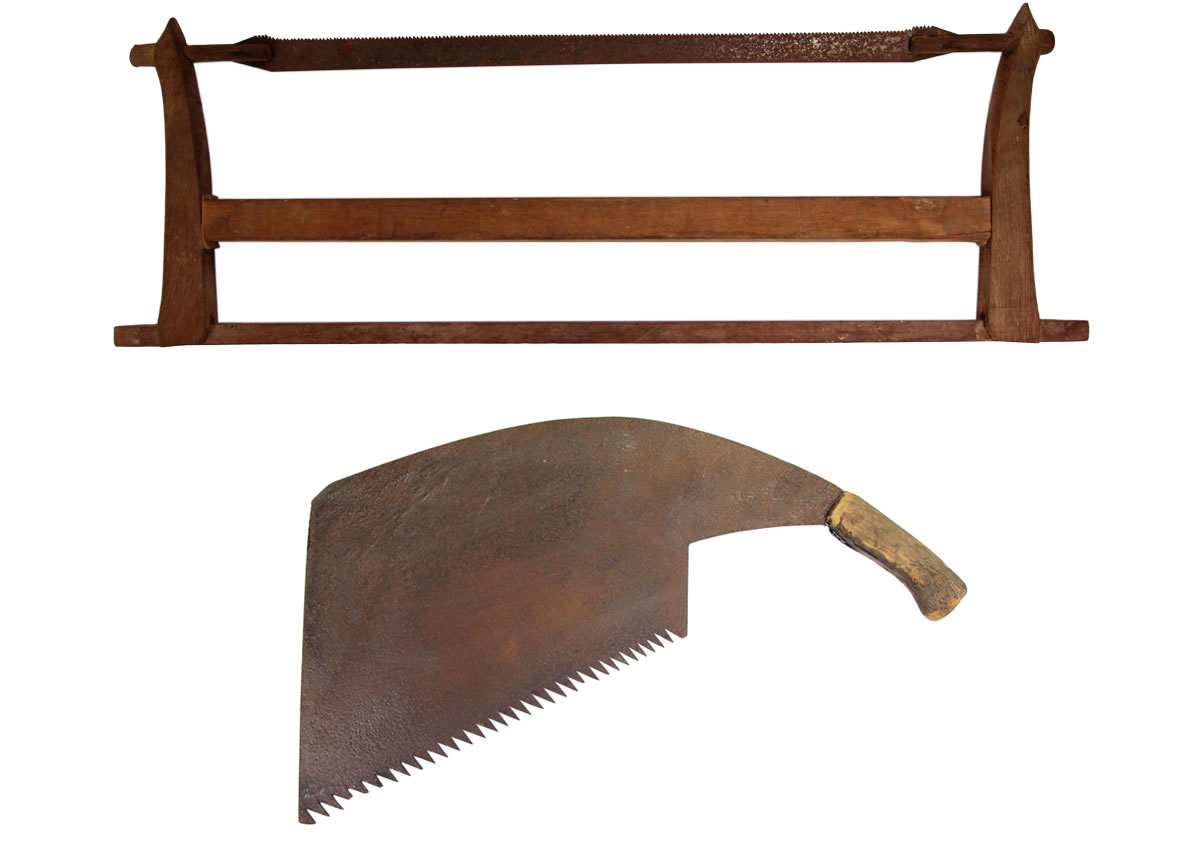
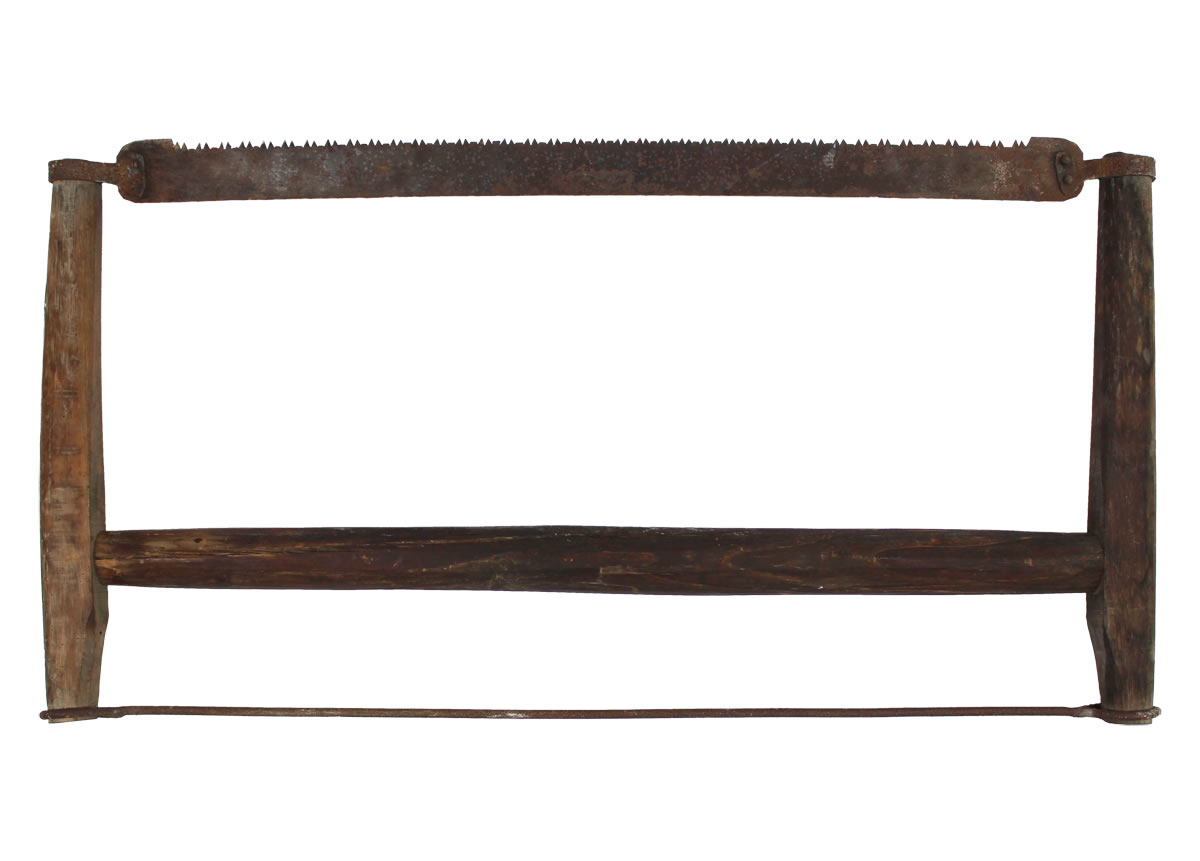
In Japanese colonial period, forest in Taiwan was systematically investigated and hewed. In order to deliver the woods, it constructed the forest railway and significantly developed forest resources. Chiayi City has been the important place of Chinese cypress at the bottom of Alishan. The former of “Ai Mu Village” was the old sawmill “Shun Yi Wood Industry”. The operation has been half a century. In early times when the forestry was vigorous, it was the plant to “cut” the giant trees. It means to cut the giant trees into pieces for medium and small woodworking factories. It was the upstream of woodworking factories. At present, there are still the hand tools of forestry used at the time, such as chopper saw, cable wire, hanger, moving hook, scriber, etc.
○Chopper saw: “Da Ge Ju” is also called “Dong Ge Ju” or “De Pou Ju”. Since it resembles a Chinese chopper, it is called chopper saw.
○Frame saw: wider “工” shape and saw blades at the bottom can be replaced.
○Carpenter saw: there is rear handle to avoid being hurt.
○Carpenter sheath: it serves for storage to avoid being hurt.
○Five teeth hole: old forestry tool. The model is special and there are big apertures between the teeth where the fibers of trees can pass through.
○Two-men saw: it can be used by two men at the same time. There are handles on both sides to lower the users’ workload.
1950-1960, collected by Mr. Yan Wei-De of Ai Mu Village
Good time in Chiayi

Wind-up disc gramophone [74]
The collector’s grandfather was a farmer in early times. He made efforts to save money to buy the expensive gramophone at the time. It shows his taste of music. Since the object is old, the sound is not clear. However, it can be played manually. It is the heirlooms left by the grandfather. On the gramophone, there is a dog listening to the gramophone. The dog on the brand label is called Nipper which missed the old master. It paid attention to the old owner’s gramophone. Thus, the new master drew it down. The parent company of HMV, Berliner Gramophone, found the label interesting and bought it. The full name of HMV was “His Master's Voice”. Although HMV has declared bankruptcy, the story of Nipper will not be forgotten. We will always remember a cute little dog sitting next to the gramophone to listen to the sound familiar to the master…We see the gramophone which passes on the grandfather’s taste to the generations.
1910-1930s, collected by Mr. Shu-Chin Tang

Unboxing journal

Origin of the name Chiayi
The original text was written by Chieh-Fu Hsu in 1936 with classical Chinese. The Hsu family in Chiayi was granted with imperial scholar in Qing Dynasty. Chieh-Fu Hsu has been well educated with literary cultivation. In Japanese colonial period, he actively participated in financial and political systems of the government. In local political circle of Chiayi, they were the most superior family.
1936, collected by Mr. Cheng-Hsin Kao

Unboxing journal

Luo Shan credit union base postcard
In Japanese colonial period, in order to encourage to the public to have regular saving, in April 1922, it called for the poster design to promote the advantages of savings as well as the manners in life, punctuality, health care, etc. It is the postcard issued by the Japanese government at the time to disseminate the decrees.
1922, collected by Mr. Cheng-Hsin Kao

Unboxing journal

Chiayi women’s political election leaflet
Campaign posters of legislative assembly and mayor of Chiayi City in Taiwan in 1950-2000s, including De-He Chang Li who run for the second session of legislative assembly and the candidates of Chiayi City mayor such as Shih-Hsien Hsu, Wen-En Chang and Bo-Ya Chang et al. In 1949, the constitution of Taiwan established modern women’s rights, specifically empowered women’s suffrage and protected women’s elective quota. However, there were few female candidates. With the affection of these women in Chiayi to the city, in local autonomy history of Chiayi City, it showed the upgrading of women’s positions and it transformed Chiayi City into “the sacred place of democracy”.
1950-2000, collected by Mr. Cheng-Hsin Kao

Unboxing journal

Patrol certificate
“Chiayi County police and civic patrol unit-patrol certificate” worn by Chiayi patrol unit at the time is historical relic which witnesses the history. The background color of cloth decoration is white and the characters are embroidered in red, including name, number and date. The date on the mottled patrol certificate shows the year when Chiayi County and City were not separated. The common item reveals the value of preservation for “Chiayi”.
1952, collected by Ms. Hsiu-Jen Liu

Treasure box of family history

Chair to transplant rice seedlings
Grandfather worked on the farm every day, bended down to transplant rice seedlings, stood up straight, walked forward and bended down again. He moved on the farm as a small spot. Grandfather got older and suffered from waist and back pain. In order to improve the situation, the family raised the money to buy a chair to transplant rice seedlings. Thus, he could work more comfortably. He cherished this chair for the work.
1960, collected by Mr. Shu-Chin Tang

Chiayi time machine

Old photo〈New Taiwan Bakery fountain circle〉
“Hinataya” was founded by the Japanese Hidetaro Yoshida in 1901. It was the first bakery in Chiayi area. When the crown prince of Japan went on an inspection tour in Taiwan, he appointed it as the imperial dessert. It was the most fashionable bakery at the time. After World War II, Mr. Lu Fu who originally worked in the shop launched the business at the site and the shop was called “New Taiwan Bakery”.
1940s, provided by New Taiwan Bakery

Chiayi time machine

Chao Qun moon cake mold
In Chinese culture, bakery molds are usually circular and it is the symbol of reunion. The decorative design represents blossom and fortune. The patterns on the cake imply luck or the topics related to good fortune. They enhance people’s imagination towards wonderful lives.
1970s, collected by Mr. Che-Hsiung Kuo

Chiayi time machine

Tools of craftsmen of foot of the incense stick
Yun Xiao community has been the largest place of feet of the incense sticks in southern Taiwan. It was said, “blossoms in the houses of Yun Xiao all year round and they are feet of the incense sticks”. In the past, the families of Yun Xiao community made a living by the technique to “make the foot of incense sticks”. Children worked with the mothers from elementary school. The technique was replaced by machines in the era of industry.
Japanese colonial period, collected by Miss. Ching-Yu Chiu

Chiayi time machine

Hongyi Lantern
We wish to return to the time with moon and light. Lanterns not only served as lighting, but also was connected with handicraft such as writing, painting and embroidery. Nowadays, Master Zhou is the only one in Chiayi who is familiar with the technique.
Provided by Hongyi Lantern

Chiayi time machine

Que Ti
Que Ti is one of the characteristics of old buildings. It was called “Jiao Ti” in Sung Dynasty and “Que Ti” in Qing Dynasty. It is the short joint with the column under the beam. It lowers the force of the joint between column and beam and avoids the tilt of the construction materials. The materials are based on the main building materials.
1910s, collected by Mr. Chien-An Kuan

Chiayi time machine

Train ticket of sugar factory railway
Get on the train with the last ticket of Beigang railway! In the past, Beigang railway operated between Chiayi and Huwei, Yunlin County. It was the simple railway operated by Huwei and Beigang sugar refineries of sugar industry in Taiwan. In the vigorous time of sugar industry in southern Taiwan, the railway was the line with the best performance and halted to the last.
1982, collected by Mr.Yi-Chia Lo


Chiayi time machine

Forestry institute poster of Government of Taiwan
Forestry institute of Government of Taiwan in Japanese colonial period was in charge of research tests of plant investigation and use and afforestation. The historical relics is the poster of the time with the characters “Chinese cypress of Taiwan” and “domestic”. The name of the company is indicated below.
Japanese colonial period, collected by Mr. Cheng-Hsin Kao

Chiayi time machine

Cabinet of Huang Wen Hospital
It was made by Chinese cypress of Taiwan and originally placed at the entrance hall of Huang Wen Hospital. There is a mirror in the middle for tidying up the appearance. At the front of the left and right sides, there is space to put the umbrellas and canes. Clothes and hats can be hung on the top. The front is decorated with chrysanthemum patterns and it shows the delicacy of the furniture at the time. Huang Wen Hospital was constructed in 1931 and it has been nearly 100 years. It has witnessed the bustling “Chiayi City Ginza”, air raid in the war, 228 Incident in Chiayi. The stories in the house and Dr. Huang Wen are connected with the history of Chiayi and even modern medical history and social history.
1958, collection of Cultural Affairs Bureau of Chiayi City

Chiayi time machine

Zhenshan Hospital horizontal inscribed board
?(ophthalmologist Chuan-Lai Liu)
Ancient objects of Chiayi City Inscribed board of appreciation of “Zhenshan Hospital” collected by Mr. Chi-Jung Kao. “Ming Kai Shih Dao” was inscribed by relief carving and gold foil on the horizontal inscribed board to convey the admiration and appreciation for the President Chuan-Lai Liu to the neighborhood. It shows the affection from the giver. “Zhenshan Hospital” has been operated for 60 years and founded by the deceased doctor Chuan-Lai Liu in the Japanese colonial period. It was highly praised by the Japanese ophthalmologist. He often held the conferences of the ophthalmology department, baseball team, professional training of midwives and participated in the charity. The hospital has been closed for years and at present, it was reconstructed as the restaurant of fish head casserole.
1932, collected by Mr. Chi-Jung Kao