>About >

Unboxing journal

Wooden box
They carry the suitcases, walk on the platform, look around and see the trains passing by slowly; they can be the travelers working away from home, the married daughters who return hometown to visit the relatives or the visitors who stay temporarily; they can be part of life of our grandparents, parents or ourselves. The boxes are from different times and different owners. Mottled box is the memory of different generations in the family.

Early Republic of China, collection of Cultural Affairs Bureau of Chiayi City

Unboxing journal

Leather case
Present, collected by Ms. Hsiu-Ru Lin


Unboxing journal

Cabinet
End of Qing Dynasty, collected by Mr. Cheng-Te Lo

Unboxing journal

Ancient lock
Iron ancient lock is the remains of the collector’s grandmother. The blue and black rust on the lock is the proof of time. ㄇ-shaped tenon serves as the lock. The collector recalls the grandmother when seeing the lock.

Unboxing journal

Origin of the name Chiayi
The original text was written by Chieh-Fu Hsu in 1936 with classical Chinese. The Hsu family in Chiayi was granted with imperial scholar in Qing Dynasty. Chieh-Fu Hsu has been well educated with literary cultivation. In Japanese colonial period, he actively participated in financial and political systems of the government. In local political circle of Chiayi, they were the most superior family.
1936, collected by Mr. Cheng-Hsin Kao

Unboxing journal

Luo Shan credit union base postcard
In Japanese colonial period, in order to encourage to the public to have regular saving, in April 1922, it called for the poster design to promote the advantages of savings as well as the manners in life, punctuality, health care, etc. It is the postcard issued by the Japanese government at the time to disseminate the decrees.
1922, collected by Mr. Cheng-Hsin Kao

Unboxing journal

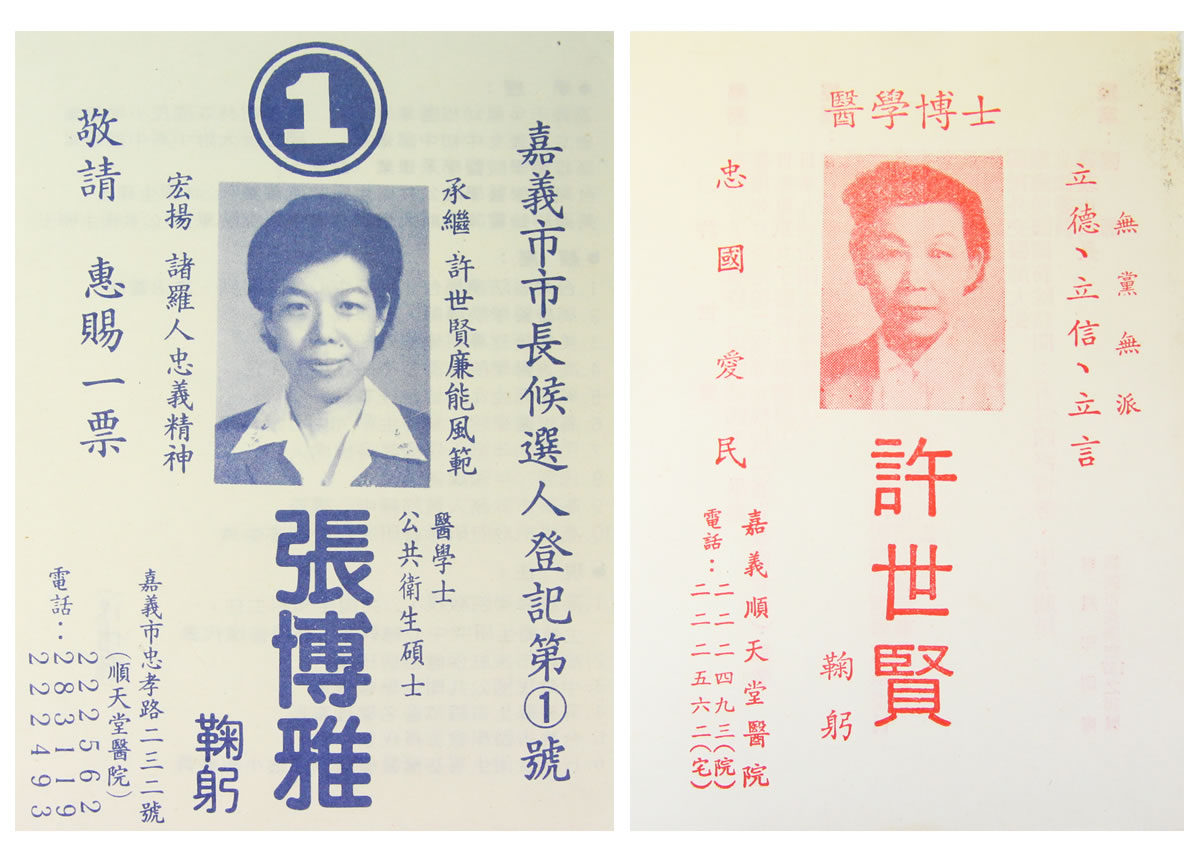
Chiayi women’s political election leaflet
Campaign posters of legislative assembly and mayor of Chiayi City in Taiwan in 1950-2000s, including De-He Chang Li who run for the second session of legislative assembly and the candidates of Chiayi City mayor such as Shih-Hsien Hsu, Wen-En Chang and Bo-Ya Chang et al. In 1949, the constitution of Taiwan established modern women’s rights, specifically empowered women’s suffrage and protected women’s elective quota. However, there were few female candidates. With the affection of these women in Chiayi to the city, in local autonomy history of Chiayi City, it showed the upgrading of women’s positions and it transformed Chiayi City into “the sacred place of democracy”.
1950-2000, collected by Mr. Cheng-Hsin Kao
Unboxing journal

Patrol certificate
“Chiayi County police and civic patrol unit-patrol certificate” worn by Chiayi patrol unit at the time is historical relic which witnesses the history. The background color of cloth decoration is white and the characters are embroidered in red, including name, number and date. The date on the mottled patrol certificate shows the year when Chiayi County and City were not separated. The common item reveals the value of preservation for “Chiayi”.
1952, collected by Ms. Hsiu-Jen Liu