>About >
1 2

Treasure box of family history

Antimony-free Metalloids enamel pattern washbasin
“Lu La La, Lu La La, Lu La Lu La Lei ……”. The water splashes and the mother tenderly touches the baby’s little body with hands opened. She carefully holds the child. The little girl was born on “day of plants”. With the parents’ care, she paid attention to the manners and was always close to her precious washbasin. However, after she grew up, she neglected it and after the marriage, she moved to other place and the washbasin was abandoned. With the time passing by, it was rusted at a corner. One day, the patterned washbasin appeared again in the hands of the old mother who told the stories of the time. It reminded her of those tender days.
1950, collected by Ms. Heng-Li Lai

Treasure box of family history

Certificate of merit of filial piety of Chuiyang
Certificate of merit of filial piety is not common nowadays on campus. When I was a student, I often shared the housework on holidays and helped my parents deliver the coal. At the time, I met the classmate who told me we should return to school. I went to school to apologize to the teacher who gave me this certificate of merit instead of blaming me. I appreciated the teacher’s reminder of filial piety by the award. I still remember it even after I grew up.
1980, collected by Ms. Chi-Hsing Chen

Treasure box of family history

Chiayi postcards [27]
Chiayi postcards in 1941 show the drawings of well-known spots in Chiayi at the time, such as Wufeng Temple, sea of clouds on Alishan, Kabuki-za, Niitakayama, Sakaemachi road, Matsu Temple, Chiayi shrine and sacred tree of Alishan. Sakaemachi road is Zhongshan Road of Chiayi City nowadays. It was the most crowded commercial district at the time. The streetlight on both sides was the columns with three lamps. The classical streetlight was common at the time. In addition, Chiayi shrine was located in Chiayi Park. In 1998, it was ratified as the municipal historical relics in Chiayi City, including Zhai Guan, Shewusuo, Shoushuishe and stone lanterns and Korean dog stone carving on both sides of Sando. After reconstruction, Zhai Guan and Shewusuo, in 2001, were opened for use and named “Chiayi City Historical Relic Museum”.
1941, collected by Mr. Che-Hsiung Kuo

Treasure box of family history

Introduction of the progress of suburbs of Chiayi
Publication to introduce Chiayi issued by Chiayi branch in Japanese colonial period on September 23, 1937. It includes the history, location, population, well-known spots, education, industry, commerce, market, finance, companies, transportation, sanitation and tourism of Chiayi with remarkable details.
Japanese colonial period, collected by Mr. Cheng-Hsin Kao

Treasure box of family history

It was edited and written by the female poet De-He Chang Li in Chiayi City. She was a talented woman and good at “poetry, calligraphy and painting”. Her artistic performance was remarkable. In poetry anthology, there were mostly political poetry and women’s poems to highlight her difference from other women of the same time.
1893-1972, collected by Mr. Chi-Jung Kao

Treasure box of family history

poetry anthology
The classical poet of Chiayi, Lai Bo-zhou, published the anthology by collecting his father’s manuscript left and his works, including the inscriptions of friends such as Yu-Ro Lai, Hui-Shun Lai, Yu-Shu Lin and De-He Li. His works were based on modern style poetry and were elegant and carefree.
1960s, collected by Mr. Chi-Jung Kao

Treasure box of family history

Dress of Xie An Temple San Jiao Chuang
Xie An Temple was called San Jiao Chuang in early times. It was founded in Qing dynasty. It was the main temple worshipped by the residents in San Jiao Chuang of Chiayi in Qing Dynasty. Tianshang Shengmu was worshipped in the temple. The dress was worn in the temple fair at the time. In 1906, it was destroyed during the earthquake of Chiayi and even torn down during the period of Kominka movement. The statue of god was moved to the private house. After the war, the followers reconstructed the temple at the original site. Xie An Temple of Chiayi is located at Wenchang street, Huanan Li, East District of Chiayi City of the present. It shows the reconstruction in 1966.
1966, collected by Mr. Chi-Jung Kao

Treasure box of family history

Tableware in Japanese colonial period
The bowl resembles a shell and the bottom color is ivory white. At the bottom of the bowl, there is a red and vivid shrimp. The stroke of indigo on the bowl resembles the wave at the beach. At the back, there are the characters “bike shop on Liu street in front of Chiayi City station (Chiayi Train Station of the present), telephone number 1056”. The shape of the bowl is delicate. Although it is the souvenir of bike shop in Japanese colonial period, the characters at the bottom show the time of Chiayi and the telephone number.
Japanese colonial period, collected by Mr. Chi-Jung Kao

Treasure box of family history

Ceramics plate
It is the plate used on the main table of the mother’s wedding feast and it is meaningful. The edge of the white bottom is decorated with golden lines. Two black carps highlight the charm of the red carp. They symbolize the surplus year after year and luck. At the time, it was filled with the luxurious delicacies. When the guests finished the food, they saw the carps and said “it is auspicious!” The mother in white dress was happy to hear it. Now when the mother recalls the time with the ceramics plate, she still feels delighted.
1920-1950, collected by Ms. Hsiu-Ru Lin

Treasure box of family history

Tool for sanitation
In 1960-1970s, sanitation in Taiwan was not satisfying and there were many mosquitoes. It is an anti-mosquito tool. The liquid medicine was poured in the cylinder of the spray to kill the mosquitoes by pressing it by hand. Afterwards, with the progress of technology, it was successively replaced by incenses.
1960-1970, collected by Mr. Cheng-Hsin Kao

Treasure box of family history

Utensils of Jiao-Zhi Pottery [38]
At the end of Qing dynasty, Jiao-Zhi Pottery was the secondary decoration of buildings. The shapes were created by the craftsmen with simple tools. Nowadays, the topics of creation of Jiao-Zhi Pottery is more diverse and the models are delicate and complicated. The craftsmen can develop the tools according to the shapes to accomplish the works. The tools to make Jiao-Zhi Pottery are from the father. It symbolizes the combination of tradition and innovation. Creative design of Jiao-Zhi Pottery remains the traditional beauty of the color of Jiao-Zhi Pottery. Besides, by the techniques of craft, it introduces Jiao-Zhi Pottery to the public.
Present, collected by Mr. Huang-Cheng Lu

Treasure box of family history

planer tool
With the progress of time and rapid industrial development, many traditional tools were successively replaced by effective and convenient electric tools. We might still see “planer tool” from old carpenters. Planer tool is the common tool of carpenter to shape, pare and make the plane. It was essential tool of the old carpenters in the past. The works particularly showed the handmade characteristics.
From 1913 to 1927, collected by Mr. Chien-An Kuan

Treasure box of family history

Wood hand tools
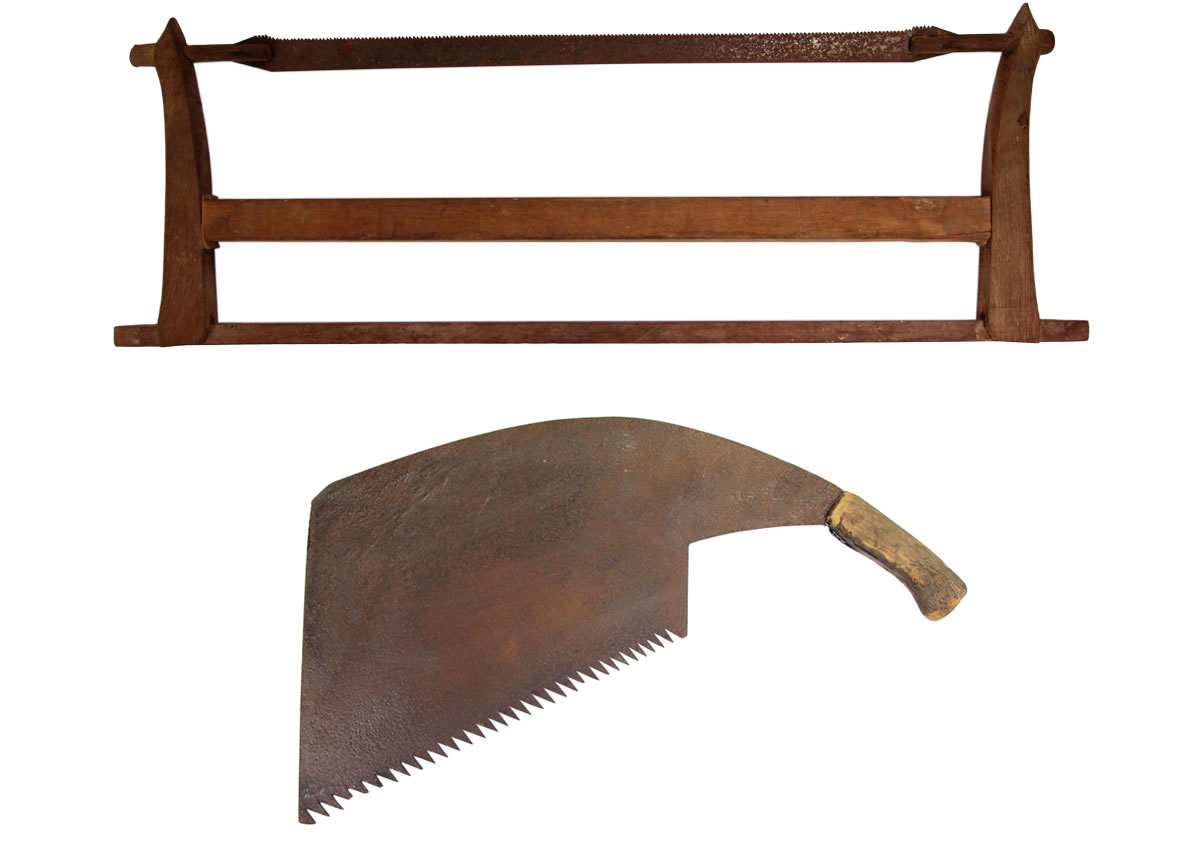
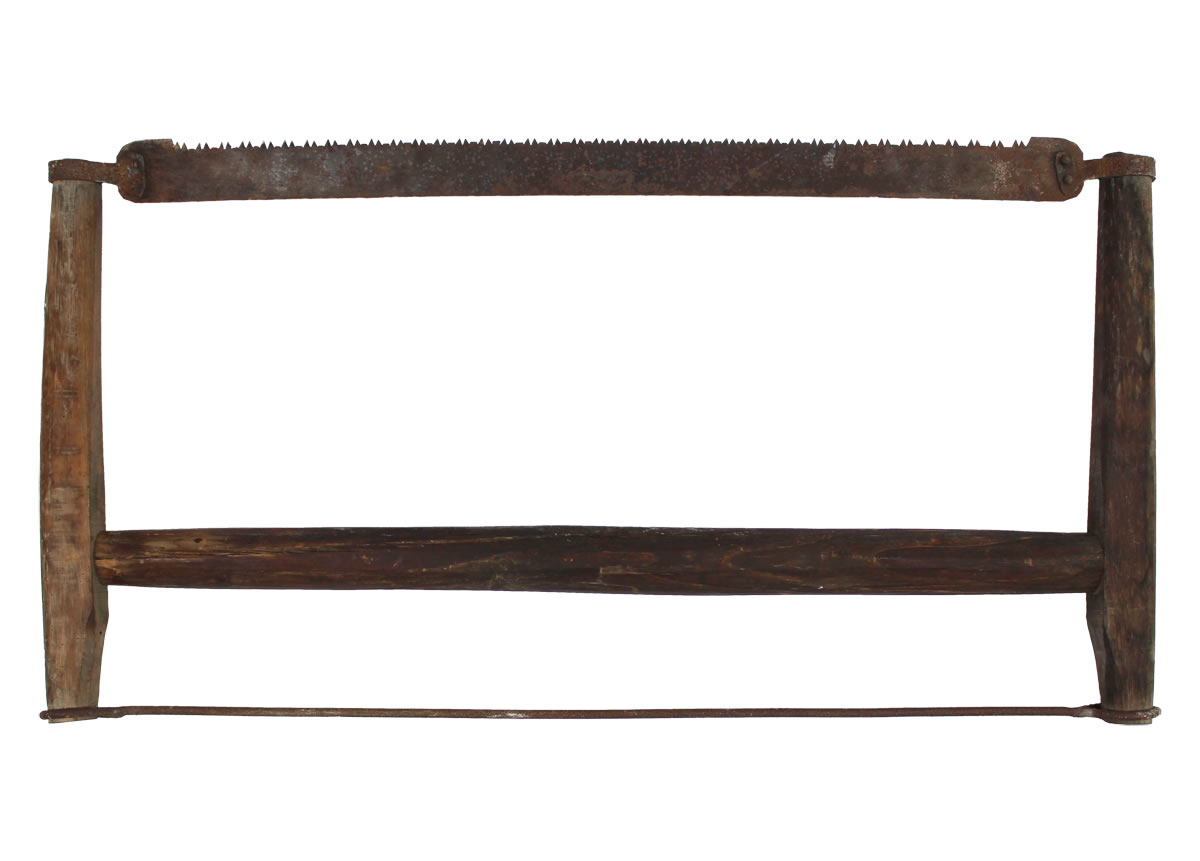
In Japanese colonial period, forest in Taiwan was systematically investigated and hewed. In order to deliver the woods, it constructed the forest railway and significantly developed forest resources. Chiayi City has been the important place of Chinese cypress at the bottom of Alishan. The former of “Ai Mu Village” was the old sawmill “Shun Yi Wood Industry”. The operation has been half a century. In early times when the forestry was vigorous, it was the plant to “cut” the giant trees. It means to cut the giant trees into pieces for medium and small woodworking factories. It was the upstream of woodworking factories. At present, there are still the hand tools of forestry used at the time, such as chopper saw, cable wire, hanger, moving hook, scriber, etc.
○Chopper saw: “Da Ge Ju” is also called “Dong Ge Ju” or “De Pou Ju”. Since it resembles a Chinese chopper, it is called chopper saw.
○Frame saw: wider “工” shape and saw blades at the bottom can be replaced.
○Carpenter saw: there is rear handle to avoid being hurt.
○Carpenter sheath: it serves for storage to avoid being hurt.
○Five teeth hole: old forestry tool. The model is special and there are big apertures between the teeth where the fibers of trees can pass through.
○Two-men saw: it can be used by two men at the same time. There are handles on both sides to lower the users’ workload.
1950-1960, collected by Mr. Yan Wei-De of Ai Mu Village
Treasure box of family history

Chair to transplant rice seedlings
Grandfather worked on the farm every day, bended down to transplant rice seedlings, stood up straight, walked forward and bended down again. He moved on the farm as a small spot. Grandfather got older and suffered from waist and back pain. In order to improve the situation, the family raised the money to buy a chair to transplant rice seedlings. Thus, he could work more comfortably. He cherished this chair for the work.
1960, collected by Mr. Shu-Chin Tang