>About >
1 2

Treasure box of family history

London pictorial publication (reproduction)
On pictorial publication of London, Britain in 1859, by interesting woodcarving illustration and characters, it introduced the life, buildings and customs of people in Southern Taiwan. It was the detailed western report on Taiwan before the Japanese occupation in Taiwan in the 19th century.
1859, collected by Mr. Cheng-Hsin Kao

Treasure box of family history

Old vacuum tube TV in 1980s
Do you remember the time when we only had monochrome TV? Vacuum tube TV was big and thick and on the upper right corner of TV, there is a circular button that we could turn. From the little box, we saw people and heard the sound and it reminds us of the wonderful childhood after 1970s and 1980s.
1980s, collected by Mr. Chi-Jung Kao

Treasure box of family history

District telephone book of Chiayi
In early times, every family had a telephone book which recorded the information of numerous shops and people. The checking included category, subcategory and strokes and it reinforced the interpersonal relationship. After the rise of internet, it replaces the function of paper telephone book. Although it is convenient, it is as interesting as the fun to turn the pages.
1974, collected by Mr. Che-Hsiung Kuo

Treasure box of family history

Finger cymbal
During the festivals, the uncle enjoyed “tau-sann-k?ng” to cheer the gods. Everyone walked on the street with strong noise to reinforce the power of performance which affected the village through the effect of music. It showed the passion to religion and gods. Everyone played the instruments and discussed the religion to accomplish the performance. It was the uncle’s favorite activity.
Japanese colonial period, collected by Mr. Shu-Chin Tang

Treasure box of family history

Jiao-Zhi Pottery
〈Chess between Nan Dou Zhen Jing and Bei Dou Zhen Jing〉
The work was made by Zhuan-You Chen and from Chiayi Chenghuang Temple. The gods competed with each other in the chess. Nan Dou Zhen Jing looks friendly and is in charge of humans’ birth; Bei Dou Zhen Jing looks fierce and is in charge of humans’ death. They both are passionate about chess and they enjoy competing with each other. It implies the fragility of life.
Work of Zhuan-You Chen, 1946, provided by Mr. Fu-Yuan Wang of Hsiang-tai Museum

Treasure box of family history

〈Wei Shui Pin Xian〉Jiao-Zhi Pottery
Chiayi Chenghuang Temple was founded in 1715. During the reconstruction from 1936 to 1938, the masters Tien-Mu Lin and Zhuan-You Chen were invited to show their competence. The work〈Wei Shui Pin Xian〉showed both the amazing techniques of Tien-Mu Lin and Zhuan-You Chen. 〈Jiang Ziya〉is the work of Tien-Mu Lin who paid attention to the lines of sculpture; 〈King Wen of Zou state〉is the work of Zhuan-You Chen who focused on the technique of dough figurine.
Works of Tien-Mu Lin and Zhuan-You Chen, Japanese colonial period, provided by Mr. Fu-Yuan Wang of Hsiang-tai Museum

Treasure box of family history

〈Kuang-I Lin〉Jiao-Zhi Pottery
Jiao-Zhi Pottery is the important craft in Chiayi and one of the gifts among the relatives and friends. The piece Kuang-I Li Jiao-Zhi Pottery is the gift from relatives. When visiting the studio of Mr. Kuang-I Lin, the collector was impressed by the work. After the collector’s retirement from the work, the relatives gave him the work as a meaningful gift.
1996, collected by Mr. An-Sen Ren

Treasure box of family history

Grandpa’s rocking chair
Beihu community of Chiayi is Beishewei before. In early times, it was the rural village with rice cultivation. The farmers mostly raised the turkeys in the backyards. At the time, the rural people tended to watch the turkeys dancing in the afternoon on the rocking chairs until the sunset to end the day.
Present, collected by Ms. Hsiu-Ru Lin

Treasure box of family history

Old photo〈Pissing boy of Dongmen Circle〉
It was taken in 1963. At the time, there were four statues of pissing boys in Dongmen Circle. The first on the left of the photo is the collector’s grandfather. At the time, it was rare to have portraits. Grandpa Guo took care of the photo carefully and looked at the photo from time to time to tell his stories to the relatives and friends. It belongs to the collector now. For the grandfather and grandchild, it is not only an old photo, but also the memory of family life in Chiayi.
1963, collected by Mr. Che-Hsiung Kuo

Treasure box of family history

Labels of True/False tobacco
Banning illegal tobacco triggered 228 Incident of Taiwan and it was the nightmare for the Taiwanese people. There are the slogans of “increase production for the country” and “anti-Communist and anti-Russian aggression” on the tobacco box which show the situations of the time. There were high profits of illegal tobacco. It is the label to compare the true and false tobacco. Can you tell?
1950s, collected by Mr. Cheng-Hsin Kao

Treasure box of family history

Life story picture books
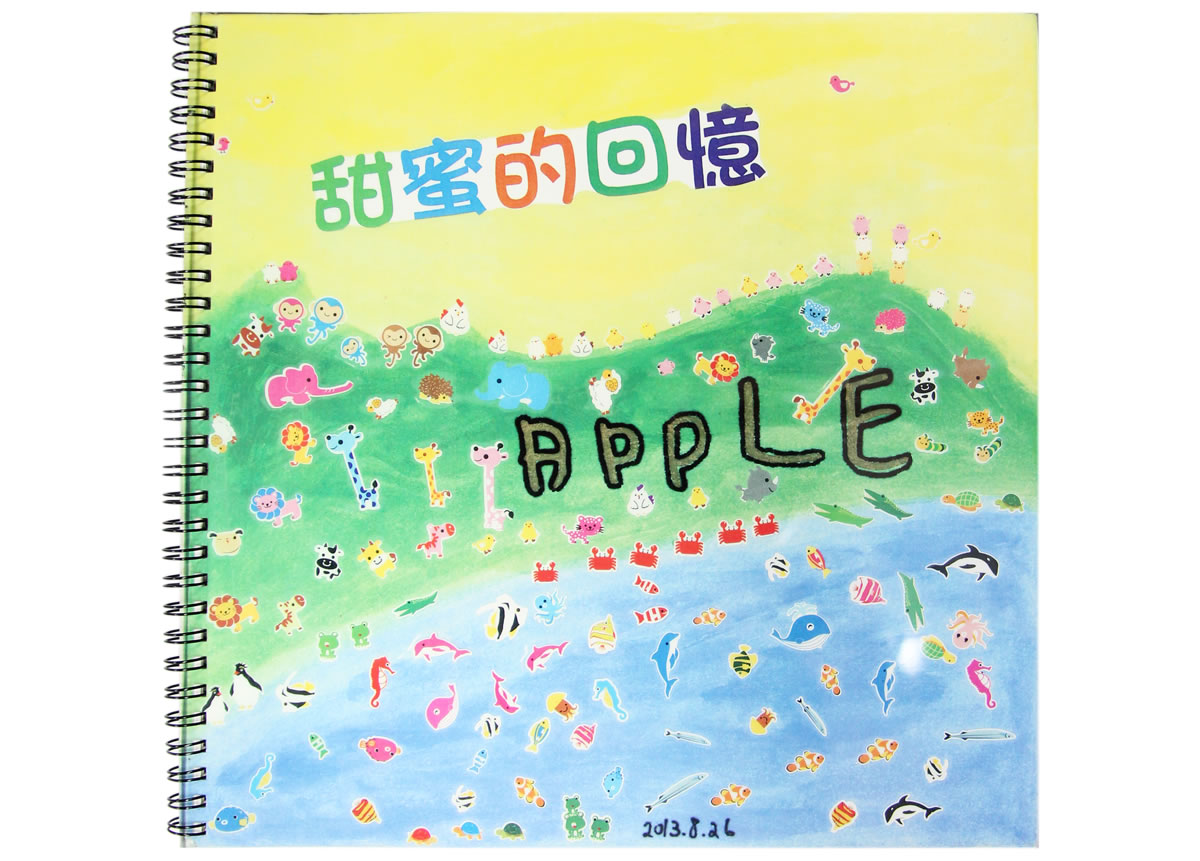
In the first picture book of life story, it shows the hand-drawing of the collector’s stories of life from childhood to the present, including the classrooms, the games of childhood, going out with friends during adolescence and taking the kid to play in the Zhongshan Park after getting married and having a child. At the bottom of the front cover, she drew the house of the childhood. Although with the change of time, the house was no longer at the same address, the affection to the house still exists. In the second picture book of life story, it records the stories of the collector’s precious granddaughter from her birth to the preschool. The detailed records and photos are the proofs of love. These two books are not only the records of life, but also the affection between grandparents and grandchild and it is priceless.
1930, created by Miss Lu Jiang Xiu Li
1990, created by Miss Lu Jiang Xiu Li and Chang Li Xin
Treasure box of family history

Charcoal iron
Charcoal iron used in early times of the Republic of China. With the time, it is partially rusted. The collector describes the memory of childhood. The mother burned the charcoal, opened the lid, put in the burned charcoal and placed the father’s clothes underneath it. With the rising smoke, the disordered clothes from the closet became brand new, just like magic. I am now a grown-up and the father is going to be retired. The time makes progress and modern people use electric iron. The charcoal iron no longer exists. However, the warmth at the time is unforgettable.
1920, provided by Mr. En-Chih Tu

Treasure box of family history

Undergarment
In early times, handmade undergarments were not only delicate, but also conveyed the warmth and blessing. Four different colors of undergarment were embroidered with different patterns. They deliver the fortune and blessing for life. As to undergarments of Taiwan, the patterns were usually embroidered first on the pieces of cloth and then on undergarments. The patterns were mostly placed on the lower pockets and embroidered borders. In addition, early undergarments were used by everyone and sometimes spices or medicinal materials were put in the pockets. Thus, they also served as spice bags and medical treatment.
Japanese colonial period, collected by Miss Wang Jin-que

Treasure box of family history

Patriotic Lottery [23]
In 1949, National Government withdrew to Taiwan. In order to solve the problems of economy, livelihood and population of great number of soldiers and people from different places in China, the government issued Patriotic Lottery to encourage the public to purchase government bond. Popularity of Patriotic Lottery in Taiwan showed the rapid growth of economy in Taiwan at the time.
1950-1987, collected by Mr. Cheng-Hsin Kao

Treasure box of family history

Patriotic Lottery [23]
1950-1987, collected by Mr. Cheng-Hsin Kao

Treasure box of family history

Jewel case [25]
It is the collector’s precious dowry when she got married. The appearance is unique and it can be used for keeping jewelry and makeup products. Every time she opened it, it reminded her of the expectation towards the future at the time. According to the collector, there is a secret which is even not known by the husband. The case is perfect for keeping personal savings!
Japanese colonial period, collected by Ms. Hsiu-Ru Lin